
Table of Contents
Introduction
Thinking about nursing school but confused about the entrance exams you may need to take?
The HESI A2 exam is an important admission assessment used by many nursing programs across the United States. For beginners, understanding the exam can make the nursing school application process feel less overwhelming. Knowing what to expect also helps you prepare with greater confidence.
So, what is the HESI exam, and why do nursing schools use it? HESI A2 stands for the Health Education Systems, Inc. Admission Assessment. It evaluates skills and subject knowledge that nursing programs may consider during admission. However, each school can have different testing requirements and score expectations.
In this beginner-friendly guide, you will learn what the HESI A2 exam is, what it tests, and how its scoring works. We will also cover common exam sections, preparation strategies, and registration basics. You will understand how to check your nursing program’s requirements before choosing study materials. By the end, you will have a clearer picture of the exam and practical next steps toward your nursing school goals.
Want to understand your practice results? Try our HESI Score Conversion Calculator to check your progress.
What Does HESI Stand For?
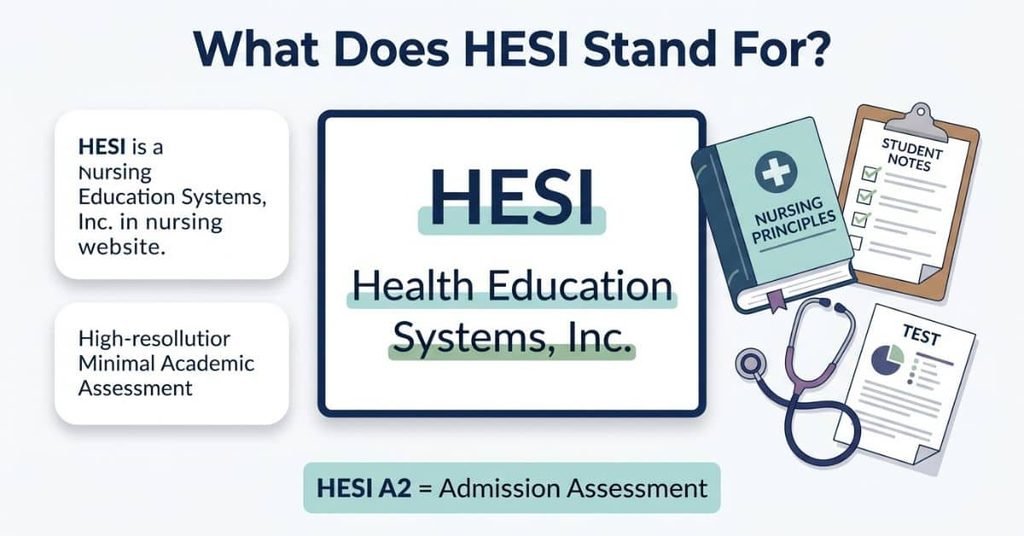
HESI stands for Health Education Systems, Inc., a name associated with educational resources and assessments for nursing students. The HESI A2 is commonly known as the Admission Assessment exam. It helps nursing programs evaluate applicants’ academic skills before they begin their studies.
Although people often use “HESI” and “HESI A2” interchangeably, the terms have different meanings. HESI refers to the broader assessment and educational system, while HESI A2 specifically refers to an admission assessment. Nursing programs may use this exam to understand applicants’ strengths in subjects related to academic readiness.
The exam can help schools evaluate skills such as reading comprehension, mathematics, vocabulary, and grammar. Some programs also require anatomy and physiology or other subject assessments. These skills matter because nursing students must understand complex information, communicate clearly, and apply scientific knowledge throughout their education.
Understanding the name and purpose of the HESI A2 is a useful first step when researching nursing school requirements. However, taking the exam does not automatically guarantee admission. Each nursing program decides how it uses assessment results during its application process.
What Is the HESI A2 Exam Used For?
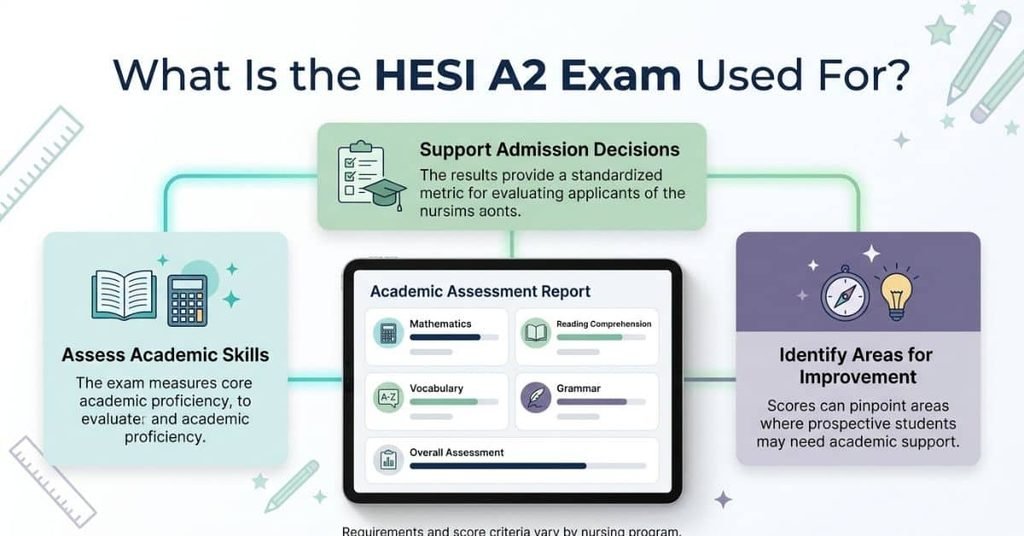
The HESI A2 exam helps nursing schools assess whether applicants have the academic skills needed to begin nursing education. Many nursing programs use it as part of their admission process, although requirements vary by school.
The assessment measures skills that support success in nursing coursework. For example, reading comprehension helps students understand textbooks and written instructions. Mathematics supports calculations used in healthcare courses, while anatomy and physiology can help students build a foundation for understanding the human body.
Schools may use HESI A2 scores in different ways. Some programs require applicants to complete several exam sections, while others focus on specific subjects. A school may also set minimum scores for individual sections or an overall result. Therefore, you should never assume that one school’s requirements apply to every nursing program.
Before registering, check the official admissions website for your chosen school. Confirm which sections you must complete, the minimum acceptable scores, testing deadlines, and retake policies. You should also ask whether the school accepts scores from remote testing or requires an approved testing center.
The key point: The HESI A2 helps nursing programs evaluate academic readiness, but each school determines how the results affect admission. Understanding those requirements early can help you prepare more effectively and avoid unnecessary testing.
What Subjects Are on the HESI A2 Exam?
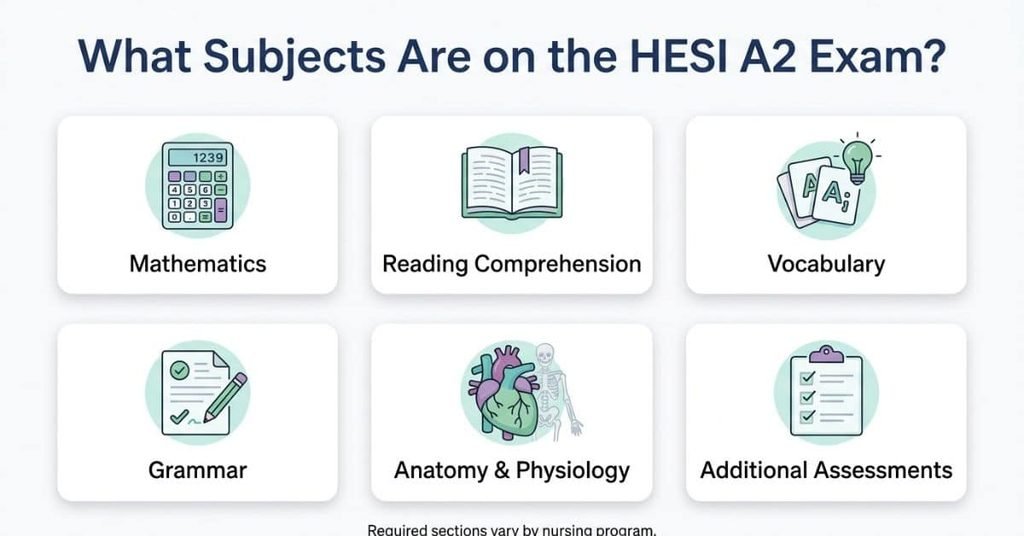
The HESI A2 exam covers academic subjects that help nursing schools evaluate applicants’ readiness for nursing education. The exact sections depend on the program you plan to enter. Many schools assess reading comprehension, mathematics, vocabulary, and grammar. Some also require anatomy and physiology or additional assessments.
Understanding each subject can help you build a focused study plan. Before you begin preparing, check your target school’s official admissions requirements to confirm which sections you must take.
Math
The HESI A2 math section evaluates basic mathematical skills that support nursing coursework. Questions may cover fractions, decimals, percentages, ratios, proportions, and basic arithmetic. You may also encounter measurement conversions and word problems that require you to apply math concepts.
For example, you might need to convert a fraction into a decimal or calculate a percentage. These questions test your ability to work accurately with numbers and follow mathematical steps.
To prepare, review essential formulas and practice solving problems without relying too heavily on a calculator. Pay particular attention to fractions, ratios, percentages, and unit conversions. Read each question carefully and check your calculations before selecting an answer.
If you need extra practice, explore our HESI Math Practice and Preparation Guide. It can help you strengthen your skills and identify topics that need more attention.
Reading Comprehension
The reading comprehension section measures how well you understand written passages. Nursing students regularly read textbooks, instructions, and educational materials, so strong reading skills are important for academic success.
Questions may ask you to identify a passage’s main idea, recognize supporting details, understand an author’s purpose, or draw conclusions from the information provided. Some questions may also test your ability to understand meaning from context.
For example, you might read a short passage about health or education and answer questions based on its content. The correct answer should reflect the passage rather than your personal opinion or outside knowledge.
To prepare, practice reading short passages and summarizing their main points. Identify key details, look for relationships between ideas, and use context clues to understand unfamiliar words. Avoid rushing through questions because small details can change the meaning.
Regular practice can help you improve both reading accuracy and confidence.
Vocabulary and General Knowledge
The vocabulary section assesses your understanding of English words and their meanings. Depending on the exam version and your school’s requirements, questions may include common academic terms, word definitions, synonyms, and antonyms.
A strong vocabulary helps you understand nursing textbooks and communicate ideas clearly. You may encounter unfamiliar words, so learning to recognize word meanings from context can be useful.
To prepare, study commonly used academic vocabulary and review words you find difficult. Flashcards can help you remember definitions, while practice questions can show how words appear in different contexts. Focus on understanding each word instead of memorizing a definition without context.
The precise vocabulary content can vary, so use study materials that match the exam sections required by your nursing program.
Grammar
The grammar section evaluates your understanding of standard written English. It may assess sentence structure, subject-verb agreement, verb tense, pronouns, punctuation, and other basic grammar rules.
These skills help nursing students communicate clearly in assignments, written examinations, and professional settings. Even small grammatical errors can change a sentence’s meaning or make information harder to understand.
For example, you may need to identify an incorrect verb form, select the grammatically correct sentence, or recognize a punctuation error. Reviewing common grammar rules can help you answer these questions more confidently.
To prepare, practice correcting sentences and identifying common mistakes. Review subject-verb agreement, pronoun usage, sentence fragments, and punctuation. When completing practice questions, read every answer choice carefully before deciding which one follows standard English grammar.
Anatomy and Physiology
Anatomy and physiology focuses on the structure of the human body and how its systems function. Some nursing programs require this subject as part of their HESI A2 admission assessment.
Anatomy examines body structures, including organs, tissues, and bones. Physiology explores how those structures work together to support essential body functions.
Depending on the required assessment, study topics may include the cardiovascular, respiratory, digestive, nervous, and skeletal systems. You may also need to understand basic terminology, organ functions, and relationships between body systems.
For example, learning how the heart circulates blood can help you understand the cardiovascular system. Reviewing diagrams and labeling major structures can make complex concepts easier to remember.
To prepare, study one body system at a time. Use diagrams, concise notes, flashcards, and practice questions to reinforce important concepts. Focus on understanding how structures function rather than memorizing isolated facts.
Check your school’s exam requirements before deciding how much time to devote to anatomy and physiology.
Other Possible Sections
Some nursing programs may require additional HESI A2 sections beyond the subjects discussed above. Depending on the institution, these may include assessments related to critical thinking, learning styles, or personality. Not every program requires these assessments, and some may use different testing arrangements.
Your school’s requirements determine which sections you need to complete. Taking unnecessary sections could waste valuable preparation time, while overlooking a required section could delay your application.
Before scheduling your exam, follow these steps:
- Visit your nursing program’s official admissions website.
- Review the required HESI A2 subjects and any minimum score requirements.
- Confirm whether the school requires all sections or only selected assessments.
- Check testing deadlines, retake policies, and accepted testing arrangements.
- Contact the admissions office if any requirements remain unclear.
Pro tip: Build your study plan around your target school’s requirements rather than a generic HESI A2 checklist. This approach helps you focus on the subjects that matter for your application.
For additional preparation, explore our HESI Study Guide for study strategies and subject-by-subject review. Always verify that your resources match the sections your school requires.
How Is the HESI A2 Exam Scored?
The HESI A2 exam reports performance across the sections you complete. These results help nursing programs evaluate your academic readiness and determine whether you meet their admission requirements. Your score report may include individual subject scores and other performance details, depending on the assessment.
Use our HESI Score Conversion Calculator to interpret your scores and identify areas for improvement.
HESI A2 scores commonly appear as percentages. However, you should understand how your nursing program interprets those results. Some schools evaluate each required section separately, while others may consider several scores during the admission process. Your school’s policies determine how these results affect your application.
There is no single passing score that applies to every nursing program. One school might require a minimum score in each subject, while another may use different admission criteria. Some programs may also consider grades, prerequisite courses, or other application requirements alongside HESI A2 results.
Before taking the exam, review your target school’s official admissions guidelines. Confirm the required sections, minimum scores, score submission deadlines, and retake policies.
If you want to understand score calculations in more detail, read our HESI Scoring Guide. You can also use our HESI Conversion Score Calculator to estimate your score using the calculator’s supported inputs.
Understanding Your Section Scores
Your section scores can help you identify strengths and weaknesses. For example, a strong reading score alongside a lower math score may indicate that you need more practice with percentages, fractions, or conversions.
Use these results to guide your preparation rather than judging your performance by one number alone. Always compare your scores with the specific requirements of your nursing program.
What Is a Good HESI A2 Score?
A good HESI A2 score depends on the nursing program you want to attend. Different schools set different admission standards, so a score that meets one school’s requirements may not meet another’s.
To evaluate your score, understand the difference between a minimum required score and a competitive score. A minimum score represents the school’s stated threshold for a particular assessment or admission requirement. A competitive score may be higher and could help strengthen your application, depending on how the program evaluates applicants.
For example, imagine two nursing programs with different score requirements. A result that satisfies the first school’s minimum may fall short of the second school’s standard. This is why you should avoid relying on general online recommendations without checking your target program.
Also, meeting the minimum HESI A2 score does not guarantee admission. Nursing programs may consider prerequisite grades, available seats, deadlines, and other eligibility criteria.
How to Decide Whether Your Score Is Good
Follow these steps to evaluate your results:
- Check the official minimum: Find the required score for each HESI A2 section your school uses.
- Review individual subjects: Identify any section where your score falls below the school’s threshold.
- Consider competitiveness: Ask the admissions office whether the program has recommended scores or evaluates applicants comparatively.
- Plan your next steps: If needed, review weaker subjects and confirm the school’s retake policy.
You can use our HESI Conversion Score Calculator to estimate your score from the information it supports. Then compare your results with your nursing program’s published requirements.
Pro tip: Set your study goal according to your target school’s standards, not an assumed universal passing score. This gives you a clearer and more practical benchmark for exam preparation.
How Hard Is the HESI A2 Exam?
The HESI A2 exam can feel challenging, especially if you’re preparing for nursing school admission for the first time. Its difficulty depends on your academic background, subject knowledge, and preparation time. Students who feel comfortable with math may find that section easier, while others may need more practice with reading comprehension or grammar.
The exam covers several academic skills, so preparing for multiple subjects can take time. You may also find certain questions challenging when they involve unfamiliar vocabulary, mathematical calculations, or detailed anatomy and physiology concepts.
Common preparation challenges include:
- Remembering formulas, fractions, percentages, and measurement conversions.
- Understanding unfamiliar words and complex reading passages.
- Reviewing anatomy and physiology terminology.
- Managing study time across multiple subjects.
- Answering questions accurately under time pressure.
You don’t need to master every subject overnight. Start by identifying your strengths and weaknesses, then build a study plan around the sections your nursing program requires.
For a more detailed discussion of exam difficulty and common challenges, read our How Hard Is the HESI A2 Exam? guide. It can help you understand what to expect before you begin preparing.
How Should You Prepare for the HESI A2 Exam?
Effective HESI A2 preparation starts with understanding your target nursing school’s requirements. Rather than studying every possible subject immediately, identify the sections you must complete. This helps you spend your time on the material that matters most for your application.
Follow these steps to create a practical study plan.
1. Identify your required exam sections. Check your nursing program’s official admissions website. Write down the required subjects, minimum scores, testing deadlines, and retake policies.
2. Create a realistic study schedule. Divide your available preparation time among the required subjects. Give more time to topics you find difficult, but continue reviewing your stronger areas.
3. Practice with relevant questions. Use practice questions to understand question formats and test your knowledge. Review incorrect answers carefully to identify mistakes and understand the correct methods.
4. Focus on weak areas. If fractions and percentages cause problems, practice those skills regularly. If anatomy and physiology feel difficult, review body systems and use diagrams to reinforce important concepts.
5. Review exam instructions. Confirm the testing format, permitted materials, identification requirements, and any rules provided by your testing provider or school.
6. Track your progress. Take practice tests when appropriate and record your results. Use your performance to adjust your study schedule instead of repeating topics you already understand.
For a more detailed preparation plan, explore our How to Study for the HESI A2 Exam guide.
Pro Tips for Better Preparation
Study consistently instead of trying to cover everything in one long session. Review mistakes, revisit difficult concepts, and use practice materials that match your required exam sections. Most importantly, confirm your school’s requirements before choosing a study plan.
Where Can You Take the HESI A2 Exam?
Where you can take the HESI A2 exam depends on your nursing program and its approved testing arrangements. Some institutions coordinate testing through their own testing centers, while others provide instructions for completing the assessment through an approved external provider.
You shouldn’t assume that every nursing school offers the same testing options. A school may specify where applicants must test, which assessment version they must complete, and how they should submit their results.
Before scheduling your exam, follow these steps:
- Visit your nursing school’s official admissions website.
- Look for instructions about HESI A2 registration and testing locations.
- Confirm whether the school requires testing at a designated center or permits another approved arrangement.
- Check available dates, registration deadlines, identification requirements, and applicable fees.
- Ask the admissions office or designated testing provider if you need clarification.
If your school directs applicants to an external testing service, follow the school’s instructions before booking. This helps you avoid choosing an assessment or testing arrangement that the program doesn’t accept.
For more information, read our Where Can You Take the HESI A2 Exam? guide. It can help you understand what to check before arranging your test.
Do All Nursing Schools Require the HESI A2 Exam?
No. Not every nursing school requires the HESI A2 exam. Admission requirements vary by institution and program, so you should check the current policies of the schools you’re considering.
Some nursing programs use the HESI A2 as part of their admission process. Others may use a different standardized entrance assessment, while some programs may follow different admission procedures. Therefore, you shouldn’t assume that taking the HESI A2 is necessary for every nursing application.
HESI A2 vs. TEAS
Two entrance assessments you may encounter when researching nursing programs are the HESI A2 and the Test of Essential Academic Skills (TEAS).
- HESI A2: An admission assessment that nursing programs may use to evaluate academic skills across required subject areas.
- TEAS: A standardized assessment developed by ATI that evaluates academic skills in areas including reading, mathematics, science, and English and language usage.
Although both assessments can support nursing-school admissions, they aren’t interchangeable by default. A school decides which test it accepts and whether applicants must meet specific section-level or overall score requirements.
Some institutions may accept one assessment but not the other. Others may have different rules for different nursing programs within the same institution.
How to Check Your School’s Requirements
Before registering for any entrance exam, review the official admissions page for your specific nursing program. Confirm the accepted test, required sections, minimum scores, deadlines, and retake rules.
If the information isn’t clear, contact the admissions office directly. Ask which assessment you need and whether the school accepts alternative tests.
Pro tip: Research admission requirements before buying study materials or scheduling an exam. Choosing the correct assessment first can save you time, money, and unnecessary preparation.
Before test day, use our HESI Score Conversion Calculator to review your results and prepare smarter.
Conclusion
Understanding what is the HESI exam can help you approach nursing school admission with greater confidence. The HESI A2 assesses academic skills, including math, reading comprehension, vocabulary, grammar, and other subjects required by specific nursing programs. Your target school’s requirements determine which sections you need and what scores you should aim for.
Preparing early, practicing regularly, and reviewing weaker subjects can make your study time more effective. Remember, there is no universal passing score for every nursing school. Always check your program’s official admission requirements before registering.
Ready to take the next step? Explore our HESI study guides and practice calculators to strengthen your preparation. If you have taken the HESI A2, share your experience in the comments to help other future nursing students.
Frequently Asked Questions
Find quick answers to common questions about the HESI A2 exam.
HESI stands for Health Education Systems, Inc. The name is associated with educational resources and assessments for nursing students. The HESI A2 is an admission assessment that some nursing programs use to evaluate applicants’ academic skills.
Not exactly. HESI refers to a broader assessment and educational system, while HESI A2 specifically refers to the Admission Assessment. People sometimes use both terms interchangeably when discussing nursing school entrance exams.
Common subjects include mathematics, reading comprehension, vocabulary, and grammar. Some nursing programs also require anatomy and physiology or additional assessments. Check your school’s admission requirements to confirm which sections you need to complete.
No. Nursing schools set their own admission requirements. Some require the HESI A2, while others accept the TEAS or use different admission criteria. Check your chosen program’s official website before registering for an exam.
Compare your results with your nursing program’s minimum score requirements. Some schools set separate thresholds for individual sections, while others use different evaluation criteria. Contact the admissions office if you need clarification about competitive scores or retake options.

We are the Math Study Tools Team, focused on creating clear and practical tools that make common math calculations easier for students. Our platform is designed to help high school and college students solve problems, check their work, and better understand the math behind their calculations.
We create student-friendly calculators and learning resources covering topics such as algebra, geometry, statistics, probability, equations, percentages, fractions, and other common mathematical concepts.
Through MathStudyTools.com, our goal is to provide useful resources that help students practice math, understand different problem-solving methods, and study with greater confidence.