

Table of Contents
Introduction
Preparing for the HESI A2 exam can feel overwhelming, especially when you don’t know how many questions to expect. Understanding the exam format is an important first step toward feeling confident and prepared.
If you’re planning to enter a nursing program in the United States, knowing how many questions are on the HESI A2 can help you organize your study time. The exam may cover several subjects, including math, reading comprehension, vocabulary, grammar, anatomy, and physiology. However, not every nursing school requires the same sections. This can make it difficult for beginners to determine exactly what they need to prepare for.
The good news is that understanding the question breakdown can make your preparation much easier. In this guide, you’ll learn how many questions the HESI A2 exam may include and how questions are distributed across different sections. You’ll also discover why the total can vary by nursing program and how to confirm your specific exam requirements. By the end, you’ll have a clearer picture of what to expect and how to prepare effectively for test day.
write this section strong
How Many Questions Are on the HESI A2 in Total?
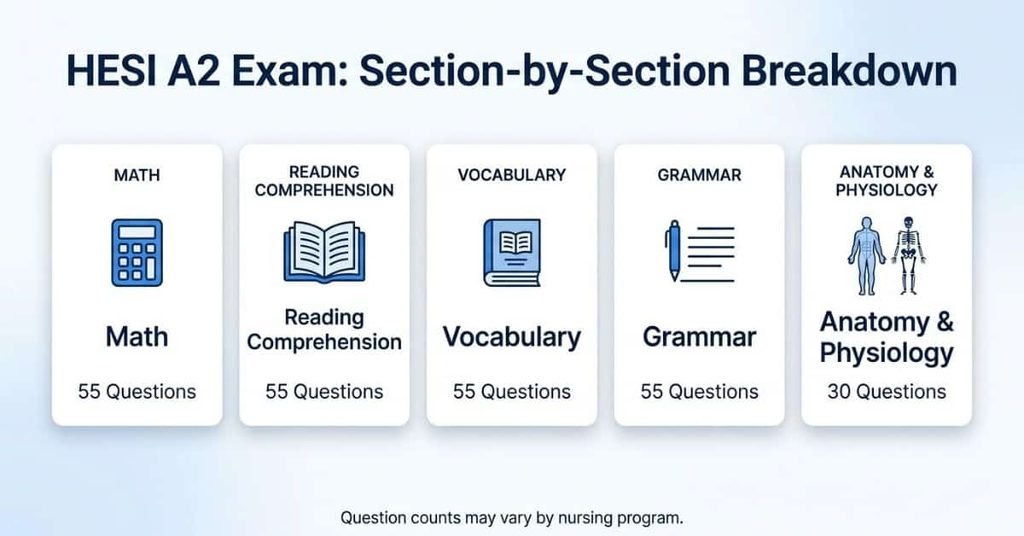
The HESI A2 exam does not have one fixed question count for every student. The total depends on which subject sections your nursing program requires. Some schools test applicants on a few subjects, while others require additional assessments.
The exam may cover reading comprehension, vocabulary, grammar, mathematics, biology, chemistry, anatomy and physiology, and other subjects. However, you usually do not need to complete every available section. Your nursing school decides which assessments you must take.
This difference matters when you plan your study schedule. For example, a student taking four required sections may face a different total than someone taking eight. Therefore, the total number of questions across all possible subjects does not necessarily represent your individual exam.
For example, Tarrant County College lists 55 questions each for reading, vocabulary, grammar, and math, plus 30 anatomy and physiology questions. That makes 250 questions when all five listed sections apply.
Other schools may use different combinations, so this example does not establish a universal total.
Before your test, check your nursing program’s official testing instructions. Confirm the required subjects, question counts, time limits, and any optional assessments. Some HESI formats also include learning-style or personality assessments, which you should distinguish from academic subject questions. Available school guides do not always clarify whether their published counts include unscored experimental questions, so verify that detail with your testing provider if needed.
Pro tip: Add the question counts for your required sections only. This gives you a more useful estimate for planning your preparation than relying on a general HESI A2 total.
How Many Questions Are in Each HESI A2 Section?
The HESI A2 exam covers several academic subjects that help nursing schools assess applicants. Each section tests a different skill, from basic calculations to reading and scientific knowledge. However, your school determines which sections you must complete.
Question counts can also vary across testing guides and school requirements. The table below uses a published college testing guide as an example, not a universal HESI A2 format. Always check your nursing program’s instructions before planning your study schedule.
| HESI A2 section | Example question count |
|---|---|
| Math | 55 |
| Reading Comprehension | 55 |
| Vocabulary and General Knowledge | 55 |
| Grammar | 55 |
| Anatomy and Physiology | 30 |
The counts above come from Tarrant County College’s official HESI A2 testing information, updated August 3, 2026. Its guide lists five sections and explains that program requirements determine which scores count.
Math
The HESI A2 math section measures your ability to solve practical mathematical problems. These skills matter in nursing education, where accuracy and careful calculations are important.
You may need to review:
- Fractions, decimals, and percentages
- Ratios and proportions
- Basic arithmetic and conversions
- Word problems and measurement calculations
Tarrant County College lists 55 math questions in its HESI A2 testing format. It also confirms that students can use an on-screen calculator during testing.
TCC Other testing arrangements may differ, so check your school’s calculator policy.
To prepare, practice solving problems without rushing. Review the steps behind each answer instead of memorizing shortcuts. Pay special attention to fractions, percentages, and unit conversions if you find them challenging.
Pro tip: Work through timed practice questions and check every incorrect answer. This helps you identify weak areas before test day.
Reading Comprehension
The reading comprehension section evaluates how well you understand written information. It tests skills that help nursing students interpret instructions, identify important details, and understand written material.
You may encounter questions about:
- The main idea of a passage
- Supporting details and key facts
- The author’s purpose or tone
- Drawing conclusions from information
- Understanding meaning from context
Tarrant County College lists 55 reading comprehension questions in its published HESI A2 format.
TCC Treat this as a school-specific example, not a guaranteed count for every applicant.
You can prepare by reading short passages and summarizing their main points. Practice distinguishing directly stated facts from conclusions you must draw. When answering questions, return to the passage to verify your choice.
Pro tip: Read the question carefully before choosing an answer. Look for evidence in the passage instead of relying on personal assumptions.
Vocabulary and General Knowledge
The vocabulary section checks your understanding of word meanings and your ability to recognize appropriate word usage. A strong vocabulary can help you understand academic passages and nursing-related study materials.
Your preparation may include:
- Common academic vocabulary
- Word definitions and synonyms
- Prefixes, suffixes, and root words
- Medical and health-related terminology
- Using context to understand unfamiliar words
Tarrant County College lists 55 vocabulary questions in its HESI A2 format.
TCC Your own exam may use a different combination of sections, so confirm the requirements with your nursing program.
Build your vocabulary by studying a small group of words daily. Write each definition in your own words and use it in a sentence. Reviewing word roots can also help you understand unfamiliar terms.
Pro tip: Use flashcards for regular review, but practice words in sentences too. This helps you understand how meanings change with context.
Grammar
The grammar section assesses your understanding of standard English rules. Clear writing and accurate communication matter in nursing school, so this section tests skills that support effective communication.
Topics may include:
- Subject-verb agreement
- Verb tenses and sentence structure
- Pronouns and their correct usage
- Punctuation and capitalization
- Common grammatical errors
Tarrant County College lists 55 grammar questions in its published HESI A2 format.
TCC However, this count reflects that college’s testing setup rather than a universal requirement.
To prepare, review basic grammar rules and practice correcting sentences. Pay attention to errors involving verb agreement, punctuation, and confusing sentence structures. Reading well-written material can also help you recognize correct grammar.
Pro tip: When reviewing practice questions, explain why an answer is correct. Understanding the rule makes it easier to recognize similar errors later.
Anatomy and Physiology
Anatomy and physiology focuses on the structure of the human body and how its systems function. This subject can help nursing programs assess your readiness for foundational healthcare coursework.
You may need to review:
- Major organs and their functions
- The skeletal and muscular systems
- The cardiovascular and respiratory systems
- Digestion and the urinary system
- Basic body-system interactions
Tarrant County College lists 30 anatomy and physiology questions in its HESI A2 testing format. However, the college states that not every program requires this section.
Start your preparation by reviewing major body systems and their primary functions. Use labeled diagrams to connect anatomical structures with their roles. Practice explaining each system in simple language instead of memorizing isolated terms.
Pro tip: Study one body system at a time. Then review how it works with other systems to reinforce your understanding.
Other Possible Assessments
Some HESI A2 testing arrangements may include additional subjects beyond the five sections listed above. Depending on the nursing program, these may include biology or chemistry. The official Admission Assessment Exam Review from Elsevier covers these subjects alongside the core academic areas.
However, a subject appearing in a study guide does not mean your school requires it on test day. Requirements depend on your program’s admissions policy and testing arrangement.
Before studying additional subjects, confirm whether your school requires any of the following:
- Biology
- Chemistry
- Other specified academic assessments
Some testing arrangements may also offer learning-style or personality assessments. These are different from academic subject tests and should not automatically count toward your academic question total.
Pro tip: Follow your school’s official testing checklist. This helps you focus on required subjects instead of spending valuable study time on sections you may not need.
Does Every Nursing School Require the Same Number of HESI A2 Questions?
No, every nursing school does not necessarily require the same HESI A2 sections. Each program sets its own admission requirements, including which subject assessments applicants must complete. As a result, the total number of questions can vary from one school to another.
For example, one nursing program might require math, reading comprehension, vocabulary, and grammar. Another might also require anatomy and physiology or additional science assessments. Since each section has its own question count, taking more required sections can increase your overall total.
Your school’s requirements also affect how you should prepare. Studying every possible HESI A2 subject may waste time if your program requires only a few sections. However, skipping a required subject could leave you unprepared for test day.
Before you begin studying, check your target nursing program’s official admissions website or testing instructions. Confirm the required subjects, accepted scores, testing format, and any deadlines. If the instructions do not list question counts, contact the admissions office for clarification.
Pro tip: If you plan to apply to multiple nursing schools, compare their HESI A2 requirements before creating your study schedule. This helps you identify shared subjects and plan for any additional assessments.
Are All HESI A2 Questions Scored?
Not every question on a HESI exam necessarily contributes to a student’s score. However, you should not assume that every HESI A2 question follows the same scoring rules without checking the applicable exam documentation.
Elsevier explains in its HESI exam documentation that some HESI exams contain both scored and unscored items. Unscored items can help evaluate questions for future use, and test takers may not know which items are unscored.
Evolve However, this document discusses HESI practical nursing exams, so it does not independently confirm the exact rules for every HESI A2 administration.
For your admission assessment, check the instructions supplied by your nursing school or testing provider. Ask whether the published question count includes any unscored items and how the exam calculates your reported results. Do not assume that you can safely skip a question because it might not count.
Your score report can also help you understand your performance across the required subject areas. If you need help interpreting the results, read our guide on [How Is the HESI A2 Scored? .
Pro tip: Answer every question carefully unless your official instructions tell you otherwise. You cannot reliably identify an unscored item just by looking at it.
How Much Time Do You Have to Answer the Questions?
The time you receive for the HESI A2 exam depends on the sections you must complete and your testing arrangement. Each subject may have its own time limit, so you should not assume that every question receives the same amount of time.
Elsevier’s official HESI Admission Assessment Faculty Scoring Guide lists these recommended times for five common sections:
| Section | Questions | Recommended time |
|---|---|---|
| Math | 55 | 50 minutes |
| Reading comprehension | 55 | 60 minutes |
| Vocabulary and general knowledge | 55 | 50 minutes |
| Grammar | 55 | 50 minutes |
| Anatomy and physiology | 30 | 25 minutes |
These figures come from Elsevier’s published guide. Your actual testing arrangement may differ, so confirm the time limits that apply to your exam.
Also, distinguish your active exam time from your total testing appointment. Your appointment may include check-in, identity verification, instructions, or other administrative steps. Those activities do not necessarily count toward your subject assessments’ time limits.
Understanding your timing helps you prepare more effectively. For example, you can practise solving math problems within the applicable time limit while allowing enough time to read passages carefully.
For a more detailed explanation of timing, read our guide on How Long Is the HESI A2 Exam? . It can help you understand exam duration and plan your test day.
Pro tip: Practise with a timer that matches your assigned section limits. Build accuracy first, then work on answering questions efficiently without rushing.
How Can You Prepare for HESI A2 Questions?
Preparing for the HESI A2 exam becomes easier when you follow a clear study plan. Instead of trying to memorize every possible topic, focus on the subjects your nursing program requires and practise the skills each section tests.
Start by confirming your required assessments. Then divide your study time among those subjects, giving extra attention to topics you find difficult.
Use these steps to organize your preparation:
- Review the required subjects. Check your nursing school’s admission instructions before choosing study materials.
- Practise different question formats. Work on math problems, reading passages, vocabulary exercises, and grammar questions. Include science practice when your program requires it.
- Review incorrect answers. Identify why you missed each question and revisit the underlying concept.
- Strengthen weak topics. Spend more time on areas where you consistently make mistakes.
- Use timed practice. Once you understand the material, practise within the time limits specified for your exam.
- Confirm test-day instructions. Check your appointment details, identification requirements, calculator rules, and permitted materials.
The official Admission Assessment Exam Review, 6th Edition, published by Elsevier, covers math, reading comprehension, vocabulary, grammar, biology, chemistry, and anatomy and physiology. It also includes practice questions and explanations to support your preparation.
For a more detailed study plan, explore our guide on How to Study for the HESI A2 Exam .
Pro tip: Keep an error log while practising. Record the topic, the reason for each mistake, and the correct method. Review that log regularly to track your progress and prepare with greater confidence.
Conclusion
Understanding how many questions are on the HESI A2 helps you prepare with greater confidence. As you’ve learned, the total depends on your nursing school’s required sections, and question counts may vary by testing arrangement. Knowing your exam format, section requirements, and time limits can make your study plan more effective.
Before test day, review your school’s official instructions and focus on the subjects you need to complete. Practise regularly, review your mistakes, and spend extra time strengthening weaker areas. You don’t need to prepare blindly when you have a clear plan.
Ready to take the next step? Explore our HESI A2 study guides for more preparation tips. Have questions or helpful study experiences? Share them in the comments to help other future nurses.
Frequently Asked Questions
Find clear answers to common questions about HESI A2 exam questions, sections, and scores.
How many questions are on the HESI A2 exam in total?
The total number of questions on the HESI A2 depends on the subjects your nursing program requires. For example, Tarrant County College lists 250 questions across five sections: math, reading comprehension, vocabulary, grammar, and anatomy and physiology. Your exam may have a different total if your school requires different sections.
Tip: Check your nursing program’s official testing instructions to confirm your required sections and question counts.
How many math questions are on the HESI A2?
Tarrant County College lists 55 math questions in its published HESI A2 testing format. However, your specific exam requirements may differ, so confirm the details with your nursing school.
Prepare by reviewing fractions, percentages, ratios, conversions, and basic arithmetic. Practising these topics can help you improve accuracy and manage your time.
Does every student take the same HESI A2 sections?
No. Nursing programs decide which subject assessments applicants must complete. Some require math, reading comprehension, vocabulary, and grammar, while others also require anatomy and physiology or additional science subjects.
Review your target school’s admissions instructions before creating your study plan. This helps you focus on the subjects you actually need.
Are HESI A2 questions multiple-choice?
HESI A2 assessments commonly use multiple-choice questions, although formats can depend on the subject and testing arrangement. You should practise interpreting passages, solving math problems, and choosing answers carefully.
Use approved practice materials and your official exam instructions to understand the question formats you may encounter.
How can I understand my HESI A2 score?
Your HESI A2 score report helps you understand your performance in the subjects you take. Each nursing program sets its own admission requirements, so a score accepted by one school may not meet another school’s expectations.
Read our guide, How Is the HESI A2 Scored? Score Calculation Explained, and use our HESI A2 score calculator to review your results.

We are the Math Study Tools Team, focused on creating clear and practical tools that make common math calculations easier for students. Our platform is designed to help high school and college students solve problems, check their work, and better understand the math behind their calculations.
We create student-friendly calculators and learning resources covering topics such as algebra, geometry, statistics, probability, equations, percentages, fractions, and other common mathematical concepts.
Through MathStudyTools.com, our goal is to provide useful resources that help students practice math, understand different problem-solving methods, and study with greater confidence.