

Table of Contents
Introduction
Are you worried about how difficult the HESI A2 exam might be before starting nursing school?
The HESI A2 exam is an important admission test for many nursing programs across the United States. It evaluates skills that help schools assess whether applicants are prepared for nursing education. If you are a beginner, understanding the test can make your preparation less stressful.
So, how hard is the HESI exam compared with other academic tests? The answer depends on your existing knowledge, study habits, and the subjects your nursing program requires. Some students struggle with math calculations, while others find anatomy and physiology or reading comprehension more challenging.
The good news is that a focused study plan can help you prepare with greater confidence. You do not need to master every subject overnight.
In this guide, you will discover what makes the HESI A2 exam challenging and which subjects may require extra attention. You will also learn practical preparation strategies, study tips, and ways to improve your performance. By understanding the exam beforehand, you can approach test day with a clearer plan and greater confidence.
Want to understand your HESI A2 score more clearly? Use our HESI A2 Score Calculator to estimate your results and understand how your performance compares with your target score.
How Hard Is the HESI A2 Exam?
The HESI A2 exam can be challenging, especially if you haven’t reviewed its subjects recently. However, its difficulty depends on your academic background, preparation, and the sections your nursing program requires. Students who understand the test format often find it easier to prepare effectively.
The exam may cover math, reading comprehension, vocabulary, grammar, and anatomy and physiology. Some nursing programs require only selected sections, while others include additional subjects. Check your school’s admission requirements before creating your study plan.
Your existing skills can also affect your results. For example, students with strong math skills may handle fractions, percentages, and conversions confidently. However, they might struggle with anatomy and physiology because it requires knowledge of body systems and medical terminology. Similarly, strong readers may find grammar rules or unfamiliar vocabulary more difficult.
Your target score matters, too. Nursing schools can set different minimum scores for admission, and some may require separate scores for specific sections. Therefore, the HESI A2 may feel manageable for one student but demanding for another.
The best approach is to identify your weak subjects early, review the required material, and practice with sample questions. Consistent preparation can help you build confidence and improve your performance on test day.
Which HESI A2 Subjects Are the Most Difficult?
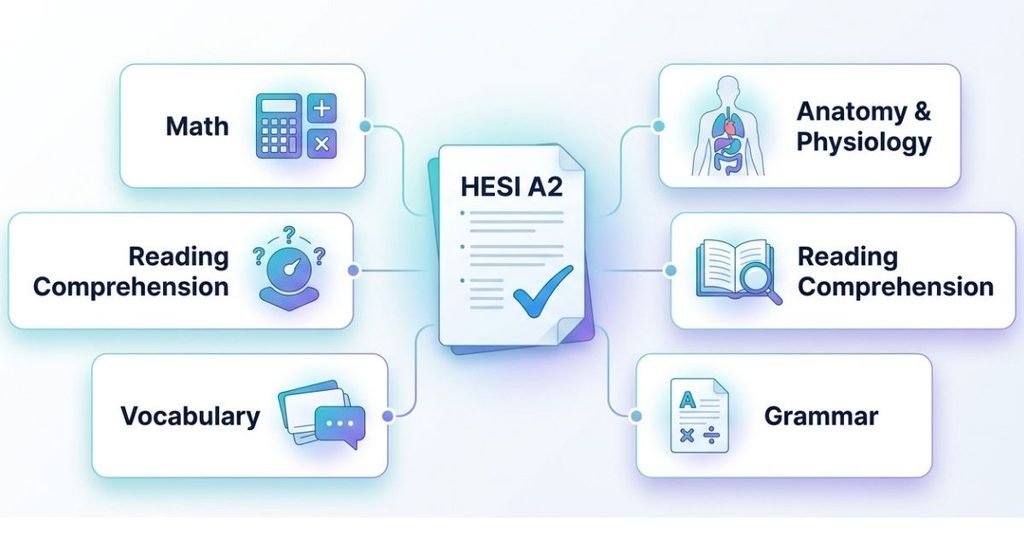
The most difficult HESI A2 subjects depend on your strengths, study habits, and previous coursework. Some students struggle with math calculations, while others need more time to understand anatomy and physiology. Reading comprehension, vocabulary, and grammar can also challenge students who haven’t reviewed these skills recently.
Before studying, check which sections your nursing program requires. Schools can select different HESI A2 subjects and set their own admission score requirements. Use the following breakdown to identify areas that may need extra practice.
HESI A2 Math
HESI A2 math can feel difficult if you haven’t practiced basic calculations recently. Common topics may include fractions, decimals, percentages, ratios, proportions, measurement conversions, and word problems.
The challenge often comes from choosing the correct operation and calculating accurately under time pressure. A small mistake when converting measurements or working with fractions can lead to an incorrect answer.
To prepare, review one topic at a time. Practice converting fractions to decimals, calculating percentages, simplifying ratios, and solving practical word problems. Show each step instead of relying on mental calculations alone.
Pay attention to units when solving conversion questions. For example, make sure you know which measurement unit the question asks for before selecting your answer. Regular practice can help you recognize question patterns and work more efficiently.
Study tip: Keep a notebook of incorrect answers. Record the mistake, review the correct method, and solve a similar question until you understand the process.
Anatomy and Physiology
Anatomy and physiology may be challenging because they require both memorization and understanding. Anatomy focuses on body structures, while physiology explains how those structures function.
Depending on your program’s required test sections, you may need to review the cardiovascular, respiratory, digestive, nervous, and other body systems. You may also encounter questions about organs, their functions, and important medical terminology.
Simply memorizing definitions may not provide enough preparation. You should understand how body parts work together and how different systems support normal body functions.
Start with one body system at a time. Use labeled diagrams, flashcards, and short practice quizzes to reinforce important terms. Explain each system in your own words to check your understanding.
Study tip: Connect each organ with its location, primary function, and related body system. This approach makes information easier to organize and recall during the exam.
Reading Comprehension
Reading comprehension tests how well you understand written passages. You may need to identify the main idea, recognize supporting details, understand an author’s purpose, or draw conclusions from information.
Students sometimes choose incorrect answers because they rely on personal assumptions instead of the passage. Other questions may include several plausible options, making it important to distinguish the main point from minor details.
To improve, read short passages and summarize each one in a single sentence. Then identify the evidence that supports the central idea. Practice answering questions about details, conclusions, and the author’s purpose.
Avoid rushing through long passages. Read the question carefully and return to the relevant section when necessary. Use the information provided rather than adding assumptions that the passage doesn’t support.
Study tip: Practice explaining what a passage says, what it suggests, and which details support your interpretation. These are different reading skills, and recognizing the difference can improve accuracy.
Vocabulary and General Knowledge
Vocabulary can challenge students when questions include unfamiliar words or terms with similar meanings. Your ability to recognize word meanings, understand context, and distinguish related terms can affect your performance.
Some HESI A2 versions or school-specific testing requirements may include vocabulary and general knowledge. However, you shouldn’t assume every nursing program requires the same sections.
Build your vocabulary by learning a manageable group of words each day. Write a simple definition, review a synonym, and use each word in a sentence. When you encounter an unfamiliar word in a passage, examine the surrounding sentences for clues.
Avoid memorizing long word lists without understanding how the words work in context. Regular review helps you retain meanings and recognize familiar terms more quickly.
If you want to check your estimated exam performance, try our HESI Conversion Score Calculator. It can help you interpret your practice results while you prepare for the HESI A2 exam.
Grammar
Grammar can be challenging if you haven’t studied formal writing rules recently. Depending on the required HESI A2 sections, you may need to review sentence structure, punctuation, subject-verb agreement, pronouns, and commonly confused words.
Some questions require you to identify an error rather than explain a grammar rule. You must recognize what makes a sentence correct and distinguish complete sentences from fragments or run-on sentences.
Begin by reviewing the basic parts of a sentence. Practice identifying subjects and verbs, correcting punctuation, and choosing the appropriate word for a sentence. Read each option carefully because small changes can affect meaning and correctness.
You can also improve by correcting short paragraphs and explaining why each change is necessary. This method builds understanding instead of encouraging guesswork.
Study tip: Focus on one grammar rule per study session. Complete practice questions, review every incorrect answer, and revisit difficult rules before moving to the next topic.
Remember, these subjects are not equally difficult for every student, and your program may not require all of them. Confirm the official test sections and score expectations with your nursing school’s admissions office before deciding where to focus your preparation.
Is the HESI A2 Harder Than Other Nursing Entrance Exams?
The HESI A2 can feel more difficult than other nursing entrance exams for some students, but there isn’t one answer for everyone. The difficulty depends on the subjects tested, your academic strengths, and how well you prepare. Your target nursing school’s admission requirements also affect which exam makes the most sense for you.
For example, a student who feels confident in reading and vocabulary may still struggle with anatomy and physiology. Another student may understand science concepts but need more practice with math calculations. Your experience with each subject can influence how challenging an exam feels.
Some nursing schools use the HESI A2, while others may accept or require a different entrance exam, such as the TEAS. These tests can differ in their content, question formats, and scoring requirements. Avoid assuming that one exam is automatically easier than the other.
Before choosing a study strategy, compare the requirements of the nursing programs you’re considering. Check which entrance exam each school accepts, which subjects it includes, and what scores applicants need.
What to do next: Review your target schools’ official admissions pages. Focus your preparation on the exam and subjects your preferred program actually requires.
Why Do Students Find the HESI A2 Difficult?
Students often find the HESI A2 challenging because it tests several academic skills. The difficulty may come from unfamiliar topics, limited study time, or pressure during the exam. Understanding your main obstacles can help you prepare more effectively.
Here are five common challenges to consider:
- Gaps in basic knowledge: Students who struggle with fractions, percentages, measurement conversions, or basic science concepts may need extra review before tackling practice questions.
- Limited preparation time: Balancing school, work, family responsibilities, and studying can make it difficult to cover every required subject.
- Unfamiliar question formats: Even students who understand a topic can make mistakes when they don’t recognize what a question asks or how to approach it.
- Time management: Spending too long on one difficult question can leave less time for others. Practicing at an appropriate pace helps you manage your available time.
- Test anxiety: Nervousness can affect concentration and make familiar questions seem harder. A realistic study routine and practice tests can help you feel more prepared.
These challenges don’t mean you’re unable to succeed. They show where your preparation may need improvement.
Start by reviewing your practice results. If you repeatedly miss math questions, revisit the underlying calculations. If you struggle with reading passages, practice identifying main ideas and supporting details.
Focus on the reason behind each mistake rather than simply memorizing the correct answer. This approach helps you build skills that you can apply to new questions.
How Can You Make the HESI A2 Easier to Prepare For?
You don’t need to study every subject at once to prepare effectively for the HESI A2. A clear plan helps you focus on the topics that need the most attention. Start by confirming your required exam sections and setting realistic study goals.
Follow these practical steps:
- Check your school’s requirements. Confirm which HESI A2 sections you must take and whether your program sets minimum scores for individual subjects.
- Identify your weak areas. Answer practice questions from each required subject. Record your results and note which topics cause the most difficulty.
- Break difficult topics into smaller sessions. Study one concept at a time, such as percentages in math or the cardiovascular system in anatomy and physiology.
- Practice calculations regularly. Work through problems step by step. Review incorrect answers and repeat similar questions until you understand the method.
- Use timed practice when appropriate. Once you understand the material, practice answering questions within a set time. This can help you build pacing skills without rushing through every question.
- Follow a consistent schedule. Divide your available study time across the required subjects. Short, regular sessions can help you review material without relying on last-minute cramming.
Pro Tips for Better HESI A2 Preparation
Keep a simple error log with three details: the question topic, why your answer was incorrect, and the correct method. Review this log regularly to spot recurring problems.
Also, take practice tests under realistic conditions when you’re ready. Use the results to adjust your study plan rather than judging your ability from one score.
For a more detailed preparation plan, explore our HESI A2 study guide. It can serve as your next step for organizing subject reviews, practice questions, and revision sessions. Replace the placeholder link with your published study guide URL before publishing.
How Much Should You Study for the HESI A2?
The amount of time you need to study for the HESI A2 depends on your current knowledge, required exam sections, and test date. Students who remember basic math and science concepts may need less review than those returning to these subjects after several years. Your goal should be to understand the material, not simply finish studying by a certain date.
Start by taking a short practice test for each required section. Review your answers and identify topics that cause repeated mistakes. This assessment helps you decide where to spend most of your study time.
Next, create a schedule that fits your daily responsibilities. Give extra attention to difficult subjects while reviewing stronger areas regularly. If anatomy and physiology feels unfamiliar, for example, divide body systems into smaller topics instead of studying everything in one session.
Your schedule should also include practice questions and time to review incorrect answers. As your test date approaches, consider completing timed practice sessions to improve your pacing.
Pro tip: Track your progress each week. If you continue making the same mistakes, adjust your study plan rather than rushing through more material. No fixed number of study days guarantees success, so focus on your understanding and readiness.
What Score Do You Need to Pass the HESI A2?
There isn’t one universal passing score for the HESI A2. Each nursing school or program can establish its own admission requirements, including minimum overall scores or individual section scores. Some programs may also consider other application requirements.
Before you begin preparing, visit your school’s official admissions website or contact its nursing admissions office. Confirm the required HESI A2 sections, minimum scores, testing deadlines, and any rules about retaking the exam. Requirements can differ between schools and may change over time.
Understanding your score helps you identify your strengths and areas that need improvement. For example, a lower score in a required subject may indicate that you should review specific concepts before your next attempt. Always compare your results with the requirements of your intended program.
You can also use a HESI Conversion Score Calculator to estimate or interpret your conversion score according to the calculator’s stated method. Check the calculator’s instructions to understand which inputs it uses and how it presents the result.
Remember that a calculator provides an estimate or calculation, not an official admission decision. It cannot replace your official score report or confirm whether you qualify for a nursing program. Your school’s admissions office remains the best source for current eligibility requirements.
Pro tip: Keep a copy of your official score report and compare each required section with your school’s published minimums. This helps you plan your next steps using accurate information.
Conclusion
So, how hard is the HESI A2 exam? Its difficulty depends on your existing knowledge, required test sections, and preparation. Math, anatomy and physiology, reading comprehension, vocabulary, and grammar may challenge students in different ways. However, identifying weak areas and following a consistent study plan can help you prepare with greater confidence.
Remember to check your nursing school’s required subjects and minimum scores before scheduling your exam. Focus on understanding concepts, practicing sample questions, and learning from your mistakes instead of relying on last-minute cramming.
Ready to start preparing? Explore our HESI A2 study guide and use the HESI Conversion Score Calculator to support your preparation. Share your biggest HESI A2 concern or study tip in the comments to help other future nursing students!

We are the Math Study Tools Team, focused on creating clear and practical tools that make common math calculations easier for students. Our platform is designed to help high school and college students solve problems, check their work, and better understand the math behind their calculations.
We create student-friendly calculators and learning resources covering topics such as algebra, geometry, statistics, probability, equations, percentages, fractions, and other common mathematical concepts.
Through MathStudyTools.com, our goal is to provide useful resources that help students practice math, understand different problem-solving methods, and study with greater confidence.