
Table of Contents
Introduction
Could your nursing GPA be different from the GPA shown on your college transcript?
If you are applying to nursing school, knowing how to calculate nursing GPA can help you understand your academic standing. Nursing programs may review your coursework in specific ways during the application process.
Your overall college GPA may not tell the whole story. Nursing programs can also consider prerequisite courses, science courses, and other academic requirements.
For students applying through NursingCAS, GPA calculations can follow application-specific rules. This can make the process confusing, especially if you are applying for the first time.
In this guide, you will learn how to calculate your nursing GPA step by step. We will explain the basic GPA formula, course credits, grade points, prerequisite GPA, and science GPA.
You will also learn how NursingCAS GPA calculation works and how to estimate your results with a nursing GPA calculator. By the end, you will have a clearer way to review your coursework before applying.
What Is a NursingCAS GPA?
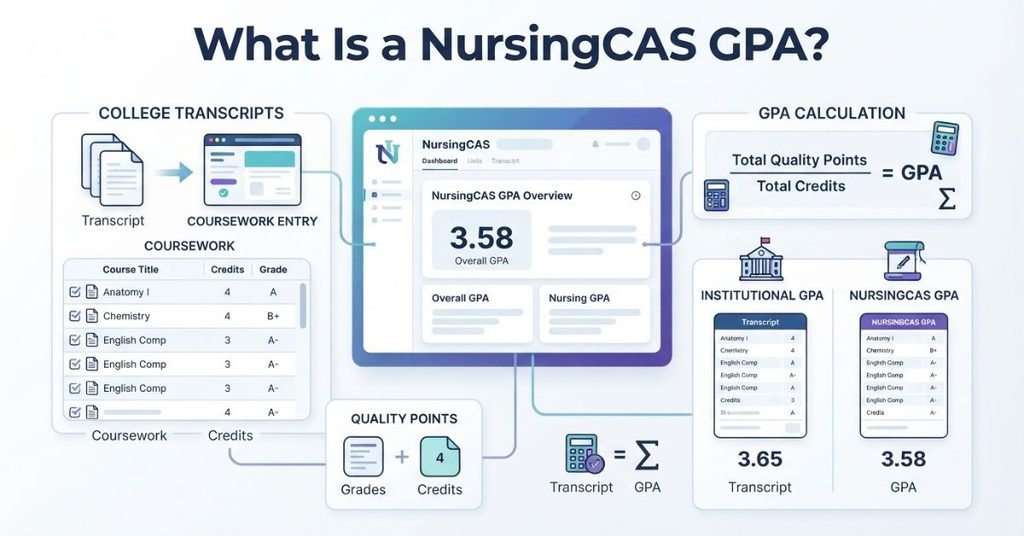
NursingCAS is a centralized application service for applicants to participating nursing programs. It lets students submit one application to multiple nursing programs.
When you apply through NursingCAS, your coursework and grades may be reviewed using standardized application-service rules. This creates a consistent way to calculate and report academic information across applicants. Your school’s GPA can still differ from the GPA shown through NursingCAS.
For example, a college may have its own rules for repeated courses, grade replacement, or credit calculations. NursingCAS uses its own calculation methodology instead. Understanding these differences can help you avoid confusion when reviewing your application.
A standardized calculation also helps nursing programs review applicants using comparable academic information. However, each nursing program can set its own admission requirements and may consider different GPA types.
If you want a quick estimate, use our NursingCAS GPA Calculator to calculate your GPA from your course grades and credits.
Nursing GPA vs. NursingCAS GPA
Your nursing school GPA usually follows the policies and grading system of your college or university. Your NursingCAS GPA follows NursingCAS calculation rules.
| Nursing School GPA | NursingCAS GPA |
|---|---|
| May follow school-specific policies | Uses NursingCAS calculation rules |
| May allow grade replacement | Repeated grades may be included |
| Can follow institution-specific rules | Follows standardized application rules |
| May use the institution’s credit system | GPA calculations are converted to semester-hour equivalents |
This difference matters when you compare your transcript GPA with your NursingCAS results. A difference does not automatically mean either calculation is wrong. They may simply use different rules.
Pro Tip: Before applying, review the current NursingCAS instructions and your nursing program’s GPA requirements. This helps you understand which GPA the program expects.
How to Calculate Nursing GPA
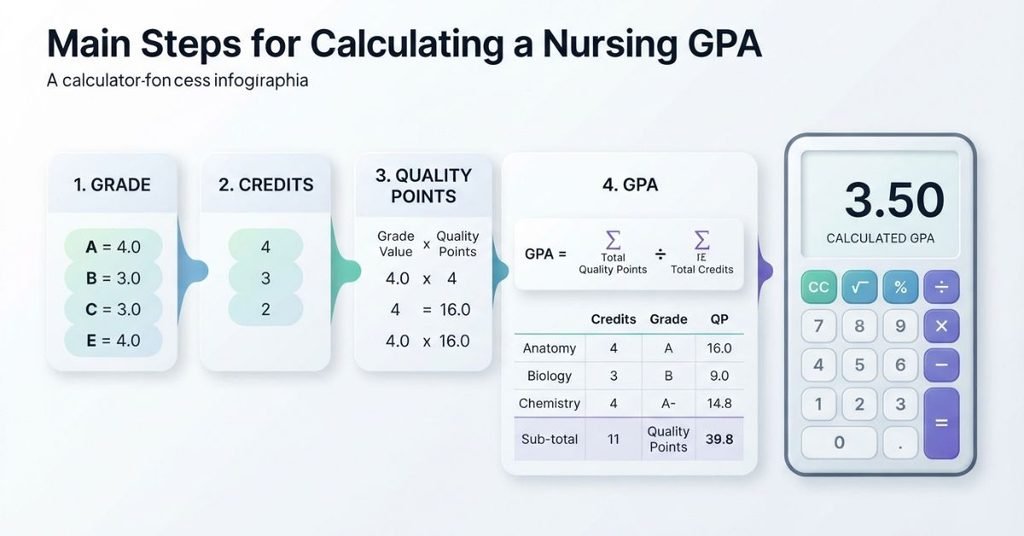
Learning how to calculate nursing GPA starts with one simple formula:
GPA = Total Quality Points ÷ Total Attempted Credits
First, calculate quality points for each course:
Quality Points = Numeric Grade Value × Attempted Credits
For example, an A worth 4.0 grade points in a three-credit course gives 12 quality points. NursingCAS uses a standardized GPA calculation process, but applicants should follow its current grade-value and coursework rules.
The basic process is simple. You list your courses, determine the applicable grade points, calculate quality points, add them together, and divide by the appropriate attempted credits.
Step 1 — List Your Courses
Start by gathering the information from your college transcripts. For each course, record:
- Course name
- Final grade
- Credit hours
- Course subject or category
- Whether you repeated the course
For applications that require full transcript entry, applicants report coursework from the institutions they attended.
Keeping this information organized makes your GPA calculation easier. It also helps you identify courses that may need special attention under NursingCAS rules.
Step 2 — Convert Grades to Grade Points
Next, convert each letter grade into its applicable numeric value. A simple example looks like this:
| Grade | Example Grade Point |
|---|---|
| A | 4.0 |
| B | 3.0 |
| C | 2.0 |
| D | 1.0 |
| F | 0.0 |
These values are examples for understanding the formula. Do not assume every college or NursingCAS calculation uses identical grade conversions. Your calculator should follow the current NursingCAS grade-value rules for the application.
Step 3 — Calculate Quality Points
Multiply each course’s attempted credits by its applicable grade-point value.
For example:
3 credits × 4.0 = 12 quality points
You can repeat this calculation for every course:
| Course | Credits | Grade Points | Quality Points |
|---|---|---|---|
| Anatomy | 3 | 4.0 | 12 |
| Biology | 3 | 3.0 | 9 |
| Chemistry | 2 | 4.0 | 8 |
| English | 3 | 1.0 | 3 |
This gives you the quality points needed for the next step.
Step 4 — Add Your Quality Points
Now add the quality points from all your courses:
12 + 9 + 8 + 3 = 32 quality points
Your total is 32 quality points.
Step 5 — Divide by Attempted Credits
Finally, divide your total quality points by your total attempted credits.
In this example:
32 ÷ 12 = 2.67 GPA
So, the example GPA is 2.67.
The same basic formula can help you estimate your GPA before applying. However, always apply the current NursingCAS rules when calculating an actual application GPA.
Instead of calculating every course by hand, you can use our NursingCAS GPA Calculator to organize your credits, grades, and quality points.
NursingCAS GPA Calculation Example
A multi-course example makes the GPA formula easier to follow. Suppose a nursing applicant has these four courses:
| Course | Grade | Credits | Quality Points |
|---|---|---|---|
| Anatomy | A | 4 | 16 |
| English | B | 3 | 9 |
| Chemistry | B | 4 | 12 |
| Psychology | A | 3 | 12 |
| Total | 14 | 49 |
First, add the quality points:
16 + 9 + 12 + 12 = 49
Next, add the attempted credits:
4 + 3 + 4 + 3 = 14
Now apply the GPA formula:
GPA = Total Quality Points ÷ Total Credits
49 ÷ 14 = 3.50
The example GPA is 3.50.
If you want to check your own courses, use the NursingCAS GPA Calculator directly after this example. Enter your courses, credits, and applicable grade values to estimate your GPA.
Does NursingCAS GPA Differ From Your College GPA?
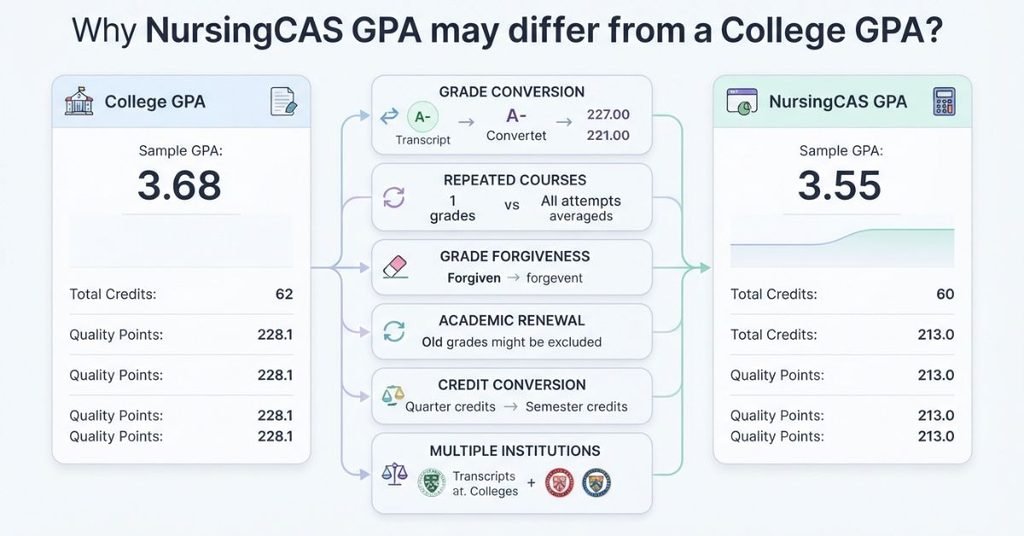
Yes, your NursingCAS GPA can differ from the GPA shown by your college. The two calculations may use different rules for grades, repeated courses, and credit conversions.
Your college GPA follows your institution’s grading policies. NursingCAS uses its own standardized calculation process for application coursework. This difference can matter when you are comparing your transcript with your application results.
Want to check your own numbers? Try our NursingCAS GPA Calculator and enter your coursework to get an estimated GPA.
Grade Replacement Policies
A college may allow a student to replace an earlier grade with a later grade. Some schools also use forgiveness or academic renewal policies when calculating their institutional GPA.
NursingCAS does not necessarily apply those institutional policies in the same way. A repeated course can therefore affect the GPA calculated for your NursingCAS application.
This means you should not automatically remove an earlier grade because your college replaced it. Check the current NursingCAS instructions when entering repeated coursework.
Different Grade Values
Your college may assign numeric values to grades using its own grading system. NursingCAS can use its own grade-value rules when calculating an application GPA.
For example, you should not assume that every transcript’s letter-grade conversion works identically. Use the applicable NursingCAS grade value when estimating your application GPA.
Quarter Credits vs. Semester Credits
Credit systems can also affect GPA calculations. NursingCAS converts quarter-hour credits into semester-hour equivalents when calculating GPAs.
The conversion used is:
1 quarter hour = 0.667 semester hours
Because NursingCAS calculates GPAs using semester hours, students from quarter-credit institutions may see different totals after conversion.
Pro Tip: Compare your college GPA with your NursingCAS estimate only after applying the appropriate NursingCAS rules. This gives you a more meaningful comparison.
How Are Repeated Courses Calculated in NursingCAS?
Retaking a course can make your nursing GPA calculation confusing. Your college may replace an old grade when calculating its institutional GPA. NursingCAS can treat repeated coursework differently.
When repeated courses appear on your official transcript, NursingCAS states that all grades earned for repeated courses are factored into its GPA calculation. This means the original grade and the new grade can both affect the calculated GPA.
For example, imagine you earned a D in Anatomy and later retook it and earned an A. Your college might use its own grade-replacement policy when reporting your institutional GPA. However, you should not simply remove the original D when estimating your NursingCAS GPA.
Instead, include the coursework according to the current NursingCAS rules. This helps prevent an estimate that looks higher than the GPA NursingCAS calculates.
Pro Tip: Always review how repeated coursework appears on your official transcript before estimating your application GPA.
How to Calculate Nursing Prerequisite GPA
A nursing prerequisite GPA measures your performance in courses required before entering a nursing program. It can differ from your overall GPA because it may include only selected prerequisite courses.
Common prerequisite courses can include subjects such as:
- Anatomy and physiology
- Microbiology
- Chemistry
- Biology
- Psychology
- English or composition
However, there is no single prerequisite GPA formula that applies to every nursing program. Each program can set its own admission requirements and decide which courses it considers prerequisites.
NursingCAS also notes that participating programs can have different coursework and transcript-entry requirements. Therefore, you should check the requirements for each nursing program you plan to apply to.
To estimate a prerequisite GPA, first identify the courses required by your target program. Then calculate the GPA using only those applicable courses and the program’s stated rules.
How to Calculate Nursing Science GPA
A nursing science GPA focuses on science-related coursework rather than every course on your transcript. It can therefore differ from your overall GPA.
Common science courses may include:
- Anatomy
- Physiology
- Microbiology
- Chemistry
- Biology
For example, strong grades in your science courses can produce a different GPA than your overall academic record. However, nursing programs may define eligible science courses differently.
One program might include certain biology or chemistry courses, while another may use a different course list. Because requirements vary, do not assume that every nursing school uses the same science GPA formula.
Before calculating your nursing science GPA, review the specific requirements for each program. Use the program’s course definitions to decide which classes belong in your estimate.
You can also use our NursingCAS GPA Calculator to estimate your GPA after entering the prerequisite courses included in your calculation.
What GPA Does NursingCAS Calculate?
NursingCAS can calculate several GPA types during the application verification process. These calculations help participating nursing programs review coursework using standardized methods.
Depending on the application and program requirements, calculated GPA information can include:
- School GPA: The GPA reported or calculated by your institution.
- Overall GPA: A GPA based on your applicable coursework.
- Academic-year GPA: A GPA organized around academic years.
- Course-subject GPA: A GPA based on particular subject areas.
- Prerequisite GPA: A GPA for required prerequisite coursework, where applicable.
NursingCAS states that it calculates several GPA types during verification. Applicants can view their calculated GPAs after the verification process.
The exact GPA information that matters can depend on the nursing programs you select. Always check each program’s admission requirements before relying on one specific GPA.
Why Is My NursingCAS GPA Different From My Transcript GPA?
Seeing different GPAs can be confusing, but several factors can explain the difference. Your college and NursingCAS may apply different calculation rules.
Common reasons include:
- Different grade conversion: NursingCAS may use applicable grade values that differ from your institution’s system.
- Repeated courses: Repeated grades can be included under NursingCAS calculation rules.
- Grade forgiveness policies: Your school may exclude an earlier grade from its institutional GPA.
- Academic renewal: Your institution may apply an academic renewal policy that changes its GPA calculation.
- Quarter-to-semester conversion: Quarter credits may be converted into semester-hour equivalents.
- Multiple institutions: NursingCAS may calculate coursework from more than one college or university.
- NursingCAS standardization: NursingCAS applies its own calculation methodology rather than simply copying your school’s GPA.
Because of these differences, your transcript GPA does not always match your NursingCAS-calculated GPA.
How to Estimate Your NursingCAS GPA Before Applying
You can estimate your GPA before submitting an application by organizing your coursework and applying the appropriate calculation rules.
Follow these steps:
- Collect your transcripts from every college or university you attended.
- List your graded courses and record each final grade.
- Record attempted credits for every applicable course.
- Convert grades according to the applicable NursingCAS grade-value rules.
- Calculate quality points for each course.
- Add all quality points together.
- Add the applicable attempted credits together.
- Divide quality points by attempted credits to estimate your GPA.
- Compare your estimate with the GPA shown by your school.
- Check each nursing program’s requirements for prerequisite, science, or other GPA expectations.
Remember that an estimate may not exactly match your final NursingCAS GPA. Verification can involve the official transcripts and NursingCAS calculation rules.
Calculate your estimated NursingCAS GPA with our NursingCAS GPA Calculator to organize your coursework and check your estimated result before applying.
Conclusion
Calculating your nursing GPA becomes easier when you understand quality points, credits, and NursingCAS rules. We covered how to calculate nursing GPA, including repeated courses, prerequisite GPA, and science GPA.
Your NursingCAS GPA may differ from your college GPA. Grade conversions, repeated courses, academic renewal, and credit conversions can affect the result. Always check the current NursingCAS guidance and your nursing program’s requirements.
If you are preparing your application, use our NursingCAS GPA Calculator to estimate your GPA before you apply. Enter your coursework and review the result as a planning estimate.
Have questions about calculating your nursing GPA? Share your experience or question in the comments. You can also explore our other nursing and education resources for more helpful tools.
“`The basic GPA formula is GPA = Total Quality Points ÷ Total Attempted Credits.
Calculate quality points by multiplying each course’s grade value by its credits. Then add the quality points and divide by the applicable attempted credits.
NursingCAS uses a standardized calculation process during application verification.
It considers reported coursework, applicable grade values, credits, and its rules for repeated coursework and credit conversion. Always follow the current NursingCAS instructions for your application.
No, not necessarily. Your college may use institutional policies for grade replacement, academic renewal, or other GPA adjustments.
NursingCAS uses its own standardized calculation methodology.
Not necessarily. NursingCAS can factor grades earned in repeated courses into its GPA calculation.
Therefore, you should not automatically remove an earlier grade based on your school’s grade-forgiveness policy.
NursingCAS calculates GPAs using semester hours.
Quarter-hour credits are converted using NursingCAS’s stated conversion before GPA calculations are performed.
Several factors can cause the difference. These include repeated grades, different grade values, grade forgiveness, academic renewal, quarter-to-semester conversions, and coursework from multiple institutions.
Prerequisite GPA calculations can be associated with programs that configure prerequisite requirements.
However, nursing programs can set different prerequisite requirements and GPA expectations. Check each program’s current requirements before calculating yours.
Yes. After your application is verified, you can access your calculated GPA information through your application PDF.
This lets you review the GPA calculated during the NursingCAS verification process.

We are the Math Study Tools Team, focused on creating clear and practical tools that make common math calculations easier for students. Our platform is designed to help high school and college students solve problems, check their work, and better understand the math behind their calculations.
We create student-friendly calculators and learning resources covering topics such as algebra, geometry, statistics, probability, equations, percentages, fractions, and other common mathematical concepts.
Through MathStudyTools.com, our goal is to provide useful resources that help students practice math, understand different problem-solving methods, and study with greater confidence.